Basel-II: New Capital Accord

Capital Adequacy Planning

Global Banking Supervision

Operational Risk Management - Basel II


Basel-II: New Capital Accord


A comprehensive e-learning product on the new capital adequacy framework
issued by the Basel Committee.

Highlight:

  • Analyze the impact of Basel-II Capital Requirements on Management Practices including Strategic
    Planning Product Pricing and Optimal Risk Profile

Basel II – New Capital Accord
Overview
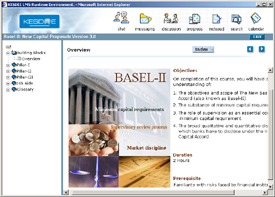
Basel-II Proposals will have a revolutionary impact on all financial institutions worldwide. The new proposals are not clarifications or amendments but wholesale revision of the Capital Accord of 1988. As the Basel Committee tries to improve on the existing system of Credit Risk and tackle the complex issues of capital for Operational Risk, the proposals introduce several new concepts.
 
Upon completion of the course, the user will be able to:
  • Understand the requirements of Basel II and its background Specify the data requirements for the key calculations involved in various approaches
  • Perform the basic calculations for both the Standardized and IRB approaches
  • Understand the advanced approaches for credit risk as well as operational risk
  • Identify the specific issues to be addressed under supervisory review process (Pillar 2)
  • Understand the general considerations with regard to disclosure requirements (Pillar 3)
For purchase, contact us at
E-mail: support@prmia.org

For online purchase, visit www.prmia.org

Basel II – New Capital Accord
 
Library of 8 Courses


Time taken to complete each Course:
Two - Three hours

1. Overview

  • Objectives and scope of Basel II
  • Substance of minimum capital requirements (Pillar–I)
  • Role of supervision
  • Broad qualitative and quantitative disclosures

2. Credit Risk – Standardised Approach

  • Risk components and risk weights for various exposure types
  • Approaches used to estimate the risk components
  • Minimum requirements for exposures
  • Techniques to mitigate credit risk

3. Credit Risk – IRB Approach

  • Various categories of exposures under the IRB approach
  • Risk components and risk weights for each category of exposure
  • Approaches used to estimate the risk components
  • Minimum requirements under each exposure to be eligible for the IRB approach

4. Credit Risk – Securitization Framework

  • Credit Risk – Securitization Framework
  • Standardized Approach for Securitization Exposures
  • Internal Ratings Based (IRB) Approach for Securitization Exposures

5. Operational Risk

  • Operational risk measurement methodologies:

    • Basic Indicator Approach (BIA)

    • Standardized Approach

    • Advanced Measurement Approaches (AMA)
  • Calculation of Operational risk capital charges using BIA and Standardized approach.
  • Qualifying criteria for use of the standardized approach and AMA

6. Market Risk

  • Definition of trading book
  • Treatment of interest rate risk
  • Treatment of equity position risk
  • Treatment of foreign exchange risk
  • Treatment of commodity risk
  • Treatment of options
  • Back testing and Stress testing.
  • The role of external validation in the Internal models approach.

7. Supervisory Review Process

  • Principles of Supervisory Review
  • Specific Issues

8. Market Discipline

  • Disclosure Requirements
  • Risk Exposure and Assessment
 

Set of 5 interactive Job Aids

  • Benchmarking Data
  • Disclosures
  • Global Best Practices
  • Regulations
  • Measurement Tools
Calculators in
Basel-II: New Capital Proposals
  1. Capital Charge For Operational Risk Under The Basic Indicator Approach
  2. Capital Charge For Operational Risk Under The Standardized Approach
  3. Capital Charge For Operational Risk Under The Alternative Approach
  4. Capital Ratio
  5. Delta-Plus Method For Options
  6. Granularity Factor
  7. Risk Weights For Corporate Exposure-IRB Approach
  8. Risk Weights For Retail Exposure-IRB Approach
  9. Weighted Maturity
  10. Probability Distributions
  11. Capital Charge For Operational Risk Under The Basic Indicator Approach (ORM)
  12. Capital Charge For Operational Risk Under The Standardized Approach (ORM)
  13. Internal Measurement Approach
  14. Maturity Ladder Approach For Commodities Risk
  15. Comprehensive Calculator On Credit Risk Based On New Capital Proposals (General)
For more information, please visit:

www.prmia.org
Top

Capital Adequacy Planning


A comprehensive e-learning product dealing with Capital Adequacy requirements
that cover Credit and Market Risks for Financial Institutions

Highlight:

  • Assess Capital Adequacy to comply with the Capital Regulations as per the 1988 Capital Accord

Capital Adequacy Planning
Overview
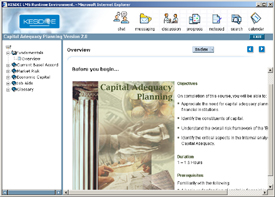
Sufficient capital is required to protect an organization’s depositors and counterparties from an institution’s on- and off-balance sheet risks. Banks need to have confidence in each other’s stability to transact business. It is therefore essential for banks to maintain adequate capital to cover their credit and market risks. This product encompasses the international standards agreed upon in July 1988 at the Bank for International Settlements. The 1996 amendment to the 1988 Capital Accord that sets out a framework for calculating the capital requirements for market risk is also covered in this product.
 
After completing this course you will be able to:
  • Understand the capital standards and other regulatory requirements, as per the capital adequacy
    directives by the Basel Accord
  • Consolidate knowledge on capital adequacy calculations
  • Assess the impact of capital requirements on management practices by defining, measuring,
    monitoring and managing risk
For purchase, contact us at
E-mail: support@prmia.org

For online purchase, visit www.prmia.org

Capital Adequacy Planning
 
Library of 7 Courses


Time taken to complete each Course:
Two - Three hours

1. Overview

  • Objectives
  • Introduction
  • What is Capital?
  • Risk Weights
  • Target Standard ratio
  • Internal Analysis of Capital Adequacy

2. Credit Risk - I

  • Objectives
  • Introduction
  • Risk Weights
  • Amendments

3. Credit Risk - II

  • Objectives
  • Introduction
  • Off-balance sheet items
  • Bilateral Netting
  • Credit Derivatives
  • Multilateral Netting

4. Market Risk Capital: Overview

  • Objectives
  • Overview to Market Risk Capital

5. Standardized measurement approach

  • Objectives
  • Interest Rate Risk
  • Equity Position Risk
  • Foreign Exchange Risk
  • Commodity Risk
  • Treatment of Options

6. Internal ratings based approach

  • Objectives
  • Introduction
  • Market risk factors and Quantitative standards
  • Stress testing and External validation
  • Combination of Approaches

7. RAROC

  • Objectives
  • Overview
  • RAROC Capital Charge and Uses
  • Case Study
 

Set of 5 interactive Job Aids

  • Benchmarking Data
  • Disclosures
  • Global Best Practices
  • Measurement Tools
  • Regulations
Calculators in
Capital Adequacy Planning
  1. Capital Ratio
  2. General Market Risk for Interest Rate Related Instruments
  3. Maturity ladder approach for Commodities Risk
  4. Delta-Plus method for Options
For more information, please visit:

www.prmia.org
Top

Global Banking Supervision


A comprehensive e-learning product with up-to-date coverage of all guidelines
issued by the Basel Committee

Highlight:

  • Measurement, Monitoring and Formulation of prudential regulations and requirements to foster the development of a framework to control risks inherent in banking as per the guidelines issued by the Basel Committee on Banking Supervision.

Global Banking Supervision
Overview
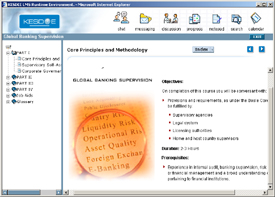
Banks serve unique economic functions, and those functions are directly related to their inherent vulnerability. Weaknesses in the banking system of a country, whether developing or developed, can threaten financial stability both within that country and internationally. In today’s financial environment, dominated by a dynamic, aggressive financial service industry, banks as major players operate with greater freedom. Banks are exposed to greater financial risks than before due to the appearance of more complex and dynamic transactions that have substantially increased uncertainties. Advances in IT technology, capital movements and geographical extension of banking business have become the new engines of global integration. What seems to be important for banking systems is not the size, but the level of compliance with the internationally accepted rules and standards, and their functionality.
 
After completing this course you will be able to:
  • Identify and understand risks inherent in Banking
  • Develop a framework to mitigate risks in accordance with the guidlelines issued by the Basel
    Committee
For purchase, contact us at
E-mail: support@prmia.org

For online purchase, visit www.prmia.org

Global Banking Supervision
 
Library of 15 Courses


Time taken to complete each Course:
Two - Three hours

1. Core Principles and Methodology

  • Before You Begin…
  • Introduction
  • Preconditions
  • Licensing Process and Changes in Structure
  • Transfer of a Bank’s Shares
  • Major Acquisitions or Investments
  • Capital Adequacy
  • Asset Quality and Reserve
  • Concentration of Risks & Large Exposures
  • Connected Lending
  • Material Risks
  • Internal Controls
  • Methods of On-Going Banking Supervision
  • Information Requirements of Banking Organizations
  • Formal Powers of Supervisors
  • Cross Border Banking
  • Additional Requirements and Self-Assessment

2. Supervisory Self-Assessment

  • Before You Begin…
  • Introduction
  • The Self-Assessment Strategy
  • Four Phases of Self-Assessment
  • Self-Assessment Report
  • Statement of Cooperation between Banking Supervisors

3. Corporate Governance in Banks

  • Before You Begin…
  • Introduction
  • Sound Corporate Governance Practices in Banking
  • The Role of Public Disclosure
  • Supervisors and Transparency
  • Recommendations for Enhancing Bank Transparency
  • Supportive Environment to Corporate Governance

4. Internal Control System

  • Before You Begin…
  • Introduction
  • Management Oversight and Control Culture
  • Risk Recognition and Assessment
  • Control Activities and Segregation of Duties
  • Information and Communication
  • Monitoring Activities and Correcting Deficiencies
  • Audit Function
  • Internal Control Deficiencies

5. Internal Audit in Banks

  • Before You Begin…
  • Introduction
  • Objectives and Tasks of the Internal Audit Function
  • Principles of Internal Audit
  • Functioning of Internal Audit
  • Supervisory Authority and Internal & External Auditors
  • Audit Committee
  • Outsourcing of the Internal Audit

6. Supervisors and External Auditors

  • Before You Begin…
  • Introduction
  • Board and Management
  • The Role of External Auditors
  • The Role of Bank Supervisor
  • Governance and Other Aspects

7. Management of Operational Risk

  • Before you Begin…
  • Introduction
  • Risk Management Environment
  • Risk Management
  • Role of Supervisors
  • Role of Disclosure

8. Liquidity Management

  • Before You Begin…
  • Introduction
  • Developing a Structure
  • Measuring and Monitoring Net Funding Requirements
  • Review Assumptions
  • Managing Market Access
  • Contingency Planning
  • Foreign Currency Liquidity Management
  • Internal Controls
  • The Role of Supervisors and Disclosures

9. Credit Risk Management

  • Before You Begin…
  • Introduction
  • Establishing Credit Risk Environment.
  • Credit Granting Process
  • Credit Administration, Measurement and Monitoring
  • Adequate Controls Over Credit Risk
  • Role of supervisors

10. Settlement Risk in Foreign Exchange

  • Before You Begin…
  • Introduction
  • The Nature of FX Settlement Risk
  • Senior Management Responsibilities
  • Duration of FX Settlement Exposure
  • Measurement of FX Settlement Exposures
  • Setting Limits and Managing Fails
  • Contingency Planning
  • Use of Bilateral Netting
  • Alternative Arrangements
  • Internal Audit and Counter Parties
  • Role of Supervisors

11. Trading and Derivatives Activities

  • Before You Begin…
  • Introduction
  • Enhancing Transparency
  • Quantitative Disclosures
  • Qualitative Disclosures

12. Risk Management Principles for E-banking

  • Before You Begin…
  • Introduction
  • Board and Management Oversight
  • Security Controls
  • Legal and Reputational Risk Management
  • Cross-Border E-Banking Activities

13. Loan Accounting and Disclosure

  • Before You Begin…
  • Introduction
  • Foundations for Sound Accounting
  • Accounting for Loans
  • Public Disclosure
  • Role of Supervisors

14. Highly Leveraged Institutions

  • Before You Begin…
  • Introduction
  • Banks’ Involvement with HLIs Credit Risk Strategy
  • Information Gathering, Due Diligence and Credit Analysis
  • Limit setting
  • Collateral, Early Termination and Other Contractual Provisions
  • Ongoing Monitoring of Positions vis-à-vis HLIs
  • Specific Actions by Banks to Implement Sound Practices

15. Dealing with weak banks

  • Before You Begin…
  • Introduction
  • Weak Banks and Problems
  • Preconditions
  • Channels for Information about Weaknesses
  • Corrective Action
  • Types of Weaknesses
  • Resolution and Exit
 
 
Set of 16 interactive Job Aids
  1. Core Principles and Methodology
  2. Corporate Governance in Banks
  3. Credit Risk Management
  4. Dealing with weak banks
  5. Highly leveraged institutions
  6. Internal Control Systems
  7. Loan Accounting and Disclosure
  8. Management and Supervision of Operational Risk
  9. Sound International Banking Supervision
  10. Risk Management for E-banking
  11. Settlement risk in foreign exchange transactions
  12. Sound practices for managing liquidity
  13. Supervisors and External Auditors
  14. Supervisors and Internal Auditors
  15. Supervisory Self-Assessment
  16. Trading and Derivatives Activities
For more information, please visit:

www.prmia.org
Top
Target Audience

Every professional involved in the global financial services industry (as a provider, user, regulator or advisor of product/services, marketplace/exchange) would benefit from KESDEE’s innovative solutions.
  • Supervisory Agencies
  • Central Banks
  • Financial Institutions
  • Commercial Banks
  • Investment Banks
  • Housing Societies/Thrifts
  • Mutual Funds
  • Brokerage Houses
  • Stock Exchanges
  • Derivatives Exchanges
  • Insurance Companies
  • Multinational Corporations
  • Accountancy Firms
  • Consultancy Firms
  • Law Firms
  • Rating Agencies
  • Multi-lateral Financial Institutions
  • Others
For purchase, contact us at
E-mail: support@prmia.org

For online purchase, visit www.prmia.org


Operational Risk Management
- Basel II


A comprehensive e-learning course library on Operational Risk Management - Basel II


Operational Risk Management - Basel II
Overview
This eLearning module comprises of a series of units or "core themes" to collectively cover the complete scope of norms and requirements as prescribed by the Basel II mandate. Beginning with an explanation of the components that form the ORM framework, describing then the risk assessment process, the subsequent units delve in to the qualitative and quantitative details in support of effective OpsRisk Management. The final two units look at management application, as well as realization/ deployment challenges.

 
Target Audience
This eLearning module is for audience with intermediate skills and expertise in risk management at banks. Typical audience will also include middle and senior management from banking departments like OpsRisk Management, Control, Auditing, Compliance, as well as Information Technology (IT).

Service providers to banks will also find these courses very relevant in establishing a sound understanding of their client's needs in support of Basel II OpsRisk Management.

  1. Course Level and Number of Courses
    Basic to intermediate level. Library of 9 Courses


  2. Instructional Method
    Dynamic, Interactive e-learning

For purchase, contact us at
E-mail: support@prmia.org

For online purchase, visit www.prmia.org


Operational Risk Management - Basel II
Library of 9 Courses


Time taken to complete each Course: One - Two hours

1. The Operational Risk Management Framework

  • Define the components that collectively form a sound operational risk management framework in support of the requirements prescribed by the Basel II Accord
  • Explain the concept of operational risk (OpsRisk), including its scope
  • Explain the required governance and organizational constructs
  • Describe OpsRisk necessary policy and processes
  • Describe functional requirements of underlying OpsRisk enabling systems

2. Risk Identification

  • Explain the concept of "risk identification" in the context of Basel II and operational risk management

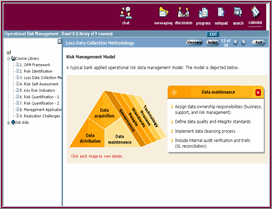
3. Loss Data Collection Methodology

  • Explain the key components of loss data collection methodology

4. Risk Self-Assessment

  • Define and explain what is risk self-assessment
  • Describe the various risk self-assessment components, including:
    • The concept of steady-state process risk and control analysis
    • Growth areas and special projects' analysis
    • Risk and control culture assessment
    • Scenario analysis
  • Explain takeaways or key considerations for developing and implementing effective risk self-assessment processes.

5. Key Risk Indicators

  • Define and explain the "key Risk Indicators" (KRIs)
  • Describe key components of a KRI framework
    • Design and rationalizing of KRIs
    • Data acquisition, maintenance, and distribution in support of KRIs
    • KRI reporting
  • Recognize KRI implementation challenges
  • Effectively summarize KRIs utilizing this course's key takeaways

6. Risk Quantification - 1

  • Define and explain the term "quantification" in conjunction with operational risk
  • Identify the key components that constitute OpsRisk quantification, namely:
    • Loss distribution approach (LDA)
    • Loss database
    • Distribution modeling
    • Loss simulation
    • Capital calculation
  • Appreciate the challenges associated with operational risk quantification
  • Identify the key considerations for developing a sound quantification model

7. Risk Quantification - 2

  • Describe the concepts of loss distribution approach (LDA)
  • Describe the concepts of loss database
  • Understand and explain distribution modeling and its various
  • Strategies in detail
  • Explain the process of loss simulation
  • Explain the different aspects of capital calculation

8. Management Applications

  • Provide an overview of the management applications
  • Analyze the key management applications:
    • Enhanced Risk Awareness
    • Actions to Reduce Operational Losses
    • Capital Planning and Risk Optimization
  • Discuss the key take-aways

9. Realization Challenges and Deployment Strategy

  • Discuss the typical challenges in the practical realization of OpsRisk capabilities and methods.
  • Describe a successful deployment approach or strategy

Job Aids

  • Exercise - Risk Inventory
  • Exercise - Loss Data Collection
  • Exercise - Risk Control Self-Assessment Creation
  • Exercise - KRI Development
  • For purchase, contact us at
    E-mail: support@prmia.org

    For online purchase, visit www.prmia.org